Behind the cold snap: What’s happening to the grid?
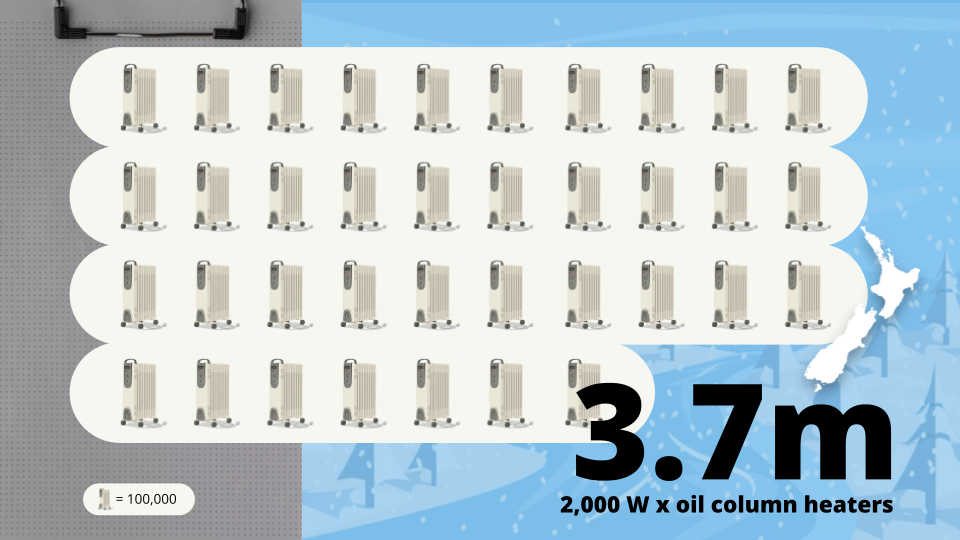
It’s as if we had turned all of our heaters on at exactly the same time!
In the past fortnight, extreme weather has pushed New Zealand's electricity grid into record territory. Transpower was forced to issue warnings to the energy sector as demand surged past 7,400 megawatts.
For context, this is more than 9 times the total max output of Huntly power station running at full capacity. Or, the equivalent of 3.7 million power-sucking 2,000-watt column heaters being turned on at the exact same second (essentially, every single house in Aotearoa turning on two high-powered heaters at once!).
When temperatures dropped to -10.4º on the Desert Road, and in usually-clement Auckland the mercury registered -2.4º, these still winter mornings brought a double whammy: freezing temperatures drove heating demand sky-high, while calm skies meant wind farms produced very little power. To keep the lights on and the heaters running, the country had to fire up coal and diesel peaker plants (like Huntly), driving spot market prices from $50 to extraordinary highs of $5,000.
The challenge of increasing energy demand
These recent events are a stark reminder of a challenge that’s only going to grow. As New Zealand continues to electrify transport, heating, cooling, and energy-intensive data centres expand across the country, the demand on our energy system will multiply exponentially.
The solution heard in public debate remains simplistic: build more power generation.
And, while new generation is essential, it’s only half the equation. Kiwis are not being told the whole story. Generating clean power in one corner of the country does little good if the transmission network, the local poles, wires, and sub-stations, cannot physically carry the heavy load during these intense peak half-hours.
In our long, skinny, and mountainous nation, the electricity grid is a complex marvel of engineering. However, this marvel is increasingly pushed to its limits. Building larger power lines everywhere is expensive, with raw materials harder to come by and taking years to consent, adding significant costs to everyone's electricity bill, which we see in our cost-of-living and productivity.
Why we built Maestro
These cold snaps have offered up a stark illustration of why we built Maestro. This is where smart grid balancing becomes the real hero - making electrons go where they’re needed, when they’re needed, precisely and automatically.
Maestro is building the digital layer of an intelligent grid. Instead of spending billions on physical infrastructure, Maestro focuses on how and when power is consumed. By connecting to the appliances already sitting in Kiwi homes and businesses, such as space heaters, heat pumps, and EV chargers, Maestro’s intelligent software makes tiny adjustments in real time. It might gently delay a space heater or EV charge cycle by a few short minutes during a critical grid peak.
To the household or business, the difference is unnoticeable. The rooms stay warm, and the EV is ready to go when needed. But across thousands of households and businesses, these coordinated micro-shifts take massive pressure off the local lines and the national transmission system.
This flexibility creates a more efficient, resilient and balanced grid that can easily absorb new commercial demands - like data centres - without falling back on expensive coal and diesel generation.
For Kiwi households, taking part in this smarter energy system directly puts cash back into their pockets through regular rewards. For businesses and lines companies, it offers a scalable way to smooth demand curves, reduce the costs associated with high peak loads, and make better use of existing infrastructure.
We don't need to rebuild the entire electricity network just to get through a few freezing winter mornings. But, we do need to be smarter with the one we’ve got to set us up for an affordable and resilient energy future. Maestro keeps homes warm, businesses humming, and the whole country moving - without skipping a beat.
Register your interest in Maestro today!